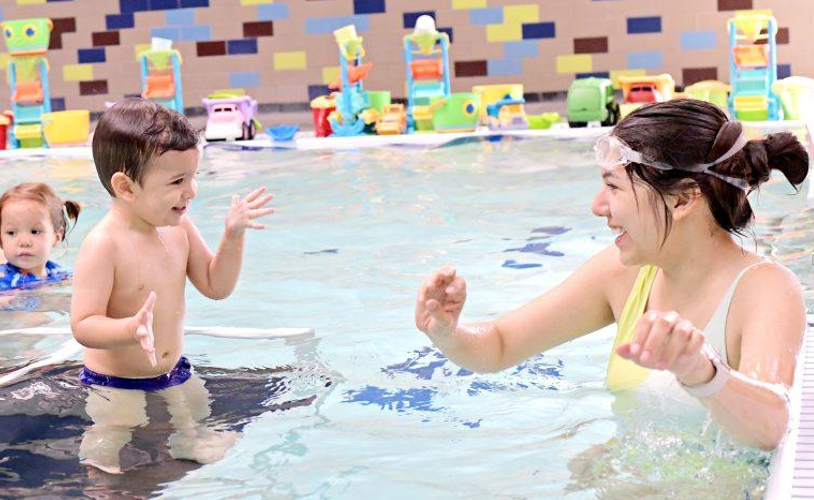
The hardest part of baby swim class isn’t the water. It’s the waiting. Waiting to see if today’s the day your baby stops crying at the edge, waiting for that first calm dip, waiting for some sign that all these weekly trips to the pool are actually adding up to something. If you’ve started searching for baby swim lessons near me, you’ve probably already noticed how little information is out there about what “progress” is even supposed to look like at this age.
Part of the problem is that baby swimming doesn’t follow a clean, visible curve the way other milestones do. There’s no equivalent of a first step or a first word. Progress happens in layers, and most of it is easy to miss if you’re watching for something dramatic.
The First Signal Isn’t Physical, It’s Behavioral
Long before your baby does anything that looks like swimming, the first real sign of progress shows up in how they act around water in general. A baby who used to stiffen up the moment they got near the pool might start relaxing their shoulders during transport into the water. One who cried through the whole car ride to lessons might start getting excited once they recognize the building.
These behavioral shifts matter because they reflect what’s happening underneath, a nervous system learning that water isn’t a threat. That shift has to happen before any physical skill can really take hold. Skipping straight to technique without this foundation usually just leads to a tense baby fighting through movements they’re not actually ready to relax into.
Reflexes Get Refined Before Skills Get Built
Babies are born with a few water-related reflexes already in place, like the gag reflex that helps prevent swallowing when submerged. Early lessons aren’t really teaching new skills so much as refining reflexes your baby already has and building on top of them intentionally.
This is why early progress can look almost identical from week to week. An instructor might spend several sessions just reinforcing the same brief submersion, adjusting timing slightly, watching how your baby’s body responds each time. It’s not lack of progress. It’s the process of turning an automatic reflex into something a baby starts anticipating and managing more calmly on their own.
Parents who understand this tend to feel less anxious watching what looks like a plateau, because they know the groundwork being laid now is what everything later depends on.
Age Changes What Progress Should Look Like
A three-month-old and a fourteen-month-old are working on completely different things in the water, even in the same general program. Younger babies are mostly building comfort and reflex response. Older babies, once they’ve developed more muscle control and body awareness, start working on intentional movement, like reaching for a wall or attempting to propel themselves forward.
Comparing progress across these age groups doesn’t make sense, but parents do it anyway, especially in group classes where babies of different ages are working side by side. A fourteen-month-old paddling toward the wall isn’t ahead of a five-month-old settling into their first calm float. They’re simply at different developmental stages with different appropriate goals.
This is also where a lot of unnecessary parent anxiety creeps in. Baby swim classes are one of the few group settings where the age range in a single room can span nearly a year, which is enormous in terms of physical development at that stage. A room with babies from four months to sixteen months old will naturally have a wide spread of ability, and none of that spread reflects how well any individual baby is doing relative to where they started. The only comparison worth making is a baby against their own baseline from a few weeks earlier.
Programs vary quite a bit in how they structure this by age, and it’s worth comparing a few different swimming schools scottsdale options to see how their class breakdowns handle these developmental differences, since lumping babies with a wide age range into one class often means the instruction ends up too advanced for some and too basic for others.
Watch for Initiation, Not Just Participation
One of the clearest markers of real progress is when a baby starts initiating something instead of just going along with what the instructor or parent is doing. A baby who used to need full physical guidance to kick might start kicking on their own when placed in position. A baby who used to be pulled through a back float might start attempting to lean back themselves when prompted.
That shift from passive participation to active initiation is a much better indicator of genuine development than how “advanced” a skill looks on the surface. A baby weakly attempting to kick on their own is often further along developmentally than one being expertly guided through a stronger-looking kick by an instructor.
Setbacks Are Part of the Process, Not a Warning Sign
Babies regularly seem to lose ground for no obvious reason. A baby who was calm and confident for weeks might suddenly start crying at drop-off again, or resist a skill they’d previously handled fine. This throws parents off more than almost anything else in baby swim lessons.
These regressions are usually tied to something outside the pool entirely, a growth spurt, teething, a change in sleep schedule, or just a developmental phase where babies become more aware of separation and new environments. They’re common enough that instructors rarely treat them as a real setback. Riding it out with consistent lessons almost always gets a baby back to where they were within a few sessions, sometimes even further along once the phase passes.
Getting frustrated or pulling a baby from lessons during one of these dips usually does more harm than the dip itself, since it interrupts the consistency that helps a baby move past it in the first place. Sticking with the regular schedule, even through a rough stretch, tends to be far more effective than pausing lessons to wait for things to feel easier again.
See also: How Can Thoughtfully Designed Residential Entertaining Spaces Enhance Everyday Living?
When to Actually Ask Questions
Most of the time, slow or uneven progress is completely normal and doesn’t need intervention. But there are moments worth flagging with an instructor directly, like a baby who seems to be regressing for several weeks straight with no clear cause, or one who still seems distressed by water even after a long stretch of regular, consistent lessons.
If you’re not sure whether what you’re seeing falls into normal variation or something worth a closer look, it helps to talk it through with someone who actually knows your baby’s history in the program rather than guessing based on general milestones. You can reach out us to walk through what you’re noticing and get a read on whether your baby’s pace is within a typical range for their age and stage.
Progress in baby swim lessons rewards patience more than almost anything else parents do in this stage of parenting. There’s no single session where it all clicks. It’s a slow accumulation of small comfort shifts, refined reflexes, and tiny moments of initiative that eventually turn into a baby who moves through water like it’s the most normal thing in the world, because by then, for them, it is.